
Checking Criminal History in Midland County
No one search contains every Midland County criminal record. Begin with the official current-detainee list when the issue is recent custody. Then use the court named in the entry to find the filed case. A felony indictment belongs with the District Clerk. Class A and B misdemeanors, plus appeals from municipal and justice courts, belong with the County Clerk. Fine-only city cases remain with Midland Municipal Court unless an appeal moves them. Older or missing records often require a direct request.
Names alone are weak identifiers. Gather the full name, aliases, date of birth, arrest date, and any warrant or cause number before starting. Compare the alleged charge with the filed charge and final disposition. One may differ from the next. For statewide public conviction and deferred-adjudication data, add the Texas DPS name search. A person reviewing their own Texas record can use fingerprints for a stronger identity match.
- Search the Midland County current-detainee page if custody may be active.
- Note the court, charge class, warrant or cause number, and arrest date.
- Ask the District Clerk, County Clerk, municipal court, or justice court for its docket and disposition.
- Request the incident or arrest report from the agency whose officer made it.
- Compare local results with DPS, then order certified court copies when proof of an outcome is needed.
The official Midland County gateway shows the county offices that support this chain.

Its separate department pages reflect the main lesson: a criminal record is distributed among custodians rather than stored at one universal counter.
Four Midland County Record Counters
The courthouse at 500 N. Loraine Street holds two key but distinct counters. The District Clerk keeps felony district-court files and uses third-floor service. The County Clerk's misdemeanor department is on the fourth floor and keeps Class A and B misdemeanor files as well as municipal and justice-court appeals. The Midland Police Records unit at 601 N. Loraine keeps city police reports. Sheriff Records, at 1703 E. County Road 120, Building A, handles sheriff reports and historic jail material that the live list does not show.
Choosing by offense level and record type avoids transfers. A felony docket does not come from the County Clerk. A city incident narrative does not come from the jail merely because the person was booked there. Municipal judicial records also follow court rules, not the standard process for an executive-agency public-information request.
District Clerk
500 N. Loraine St., Midland, TX 79701
432-688-4500
Felony district-court records
County Clerk
500 N. Loraine St., fourth floor
432-688-4402
Class A and B misdemeanor records
Sheriff Records
1703 E. County Road 120, Building A
432-688-4660
Reports and jail-record requests
Midland Police Records
601 N. Loraine St., Midland, TX 79701
432-685-7145
City incident and arrest reports
The county's official locations page illustrates the split among the courthouse, Warrant Services, supervision, and other justice offices.

Check the named court or office before travel because the county does not publish one blanket rule for parking, phones, or every courtroom's entry procedures.
Texas Official Background Checks
The Texas Department of Public Safety Crime Records Division runs the public Criminal History Conviction Name Search. Any member of the public may create an account, buy credits, and search public Texas conviction and deferred-adjudication information. Each online search credit costs $1. A credit-card order adds 2.25 percent per credit and $0.25 per transaction. DPS also describes a $10 offline name check. Similar names can create a false match, while incomplete identifiers can miss the right person.
A fingerprint review serves a different aim. A person may review their own Texas history through Fingerprint Applicant Services of Texas, delivered by IdentoGO. DPS lists a $15 record check plus a $10 FAST fingerprint fee. Fingerprints improve identity matching, but the result still depends on agencies having sent accurate arrest and disposition data. Certified local court records remain the best proof of what a Midland case decided.
| Official channel | Best use | Stated cost |
|---|---|---|
| DPS online name search | Public convictions and deferred adjudications reported in Texas | $1 credit per search, plus stated card charges |
| DPS offline name check | Alternate statewide name route | $10 |
| FAST fingerprint review | Review of one's own fingerprint-linked Texas record | $15 check plus $10 FAST fee |
| Midland clerk copy | Proof of a local filed case or disposition | Confirm with the proper clerk |
Midland County DPS and Clerk Searches
A DPS result and a Midland County clerk file answer different questions. DPS compiles public conviction and deferred-adjudication data reported from across Texas. The District Clerk or County Clerk preserves the instruments and docket for one local prosecution. A clerk file may show a complaint, information or indictment, motions, hearings, plea, judgment, sentence, costs, and later appellate activity. DPS does not replace those source papers.
Start with the statewide product when the county is unknown or when a self-review needs a broad Texas layer. Start with the clerk when the goal is to understand a known Midland case. Use a cause number whenever possible. If the statewide entry has the wrong outcome, obtain a certified disposition from the right clerk and follow DPS correction instructions.
The DPS conviction search information page explains account and credit access.

The screen is a statewide starting point, not a certified claim that no other Midland County criminal record exists.
For local felony work, the Midland County District Clerk page identifies that office's criminal jurisdiction.
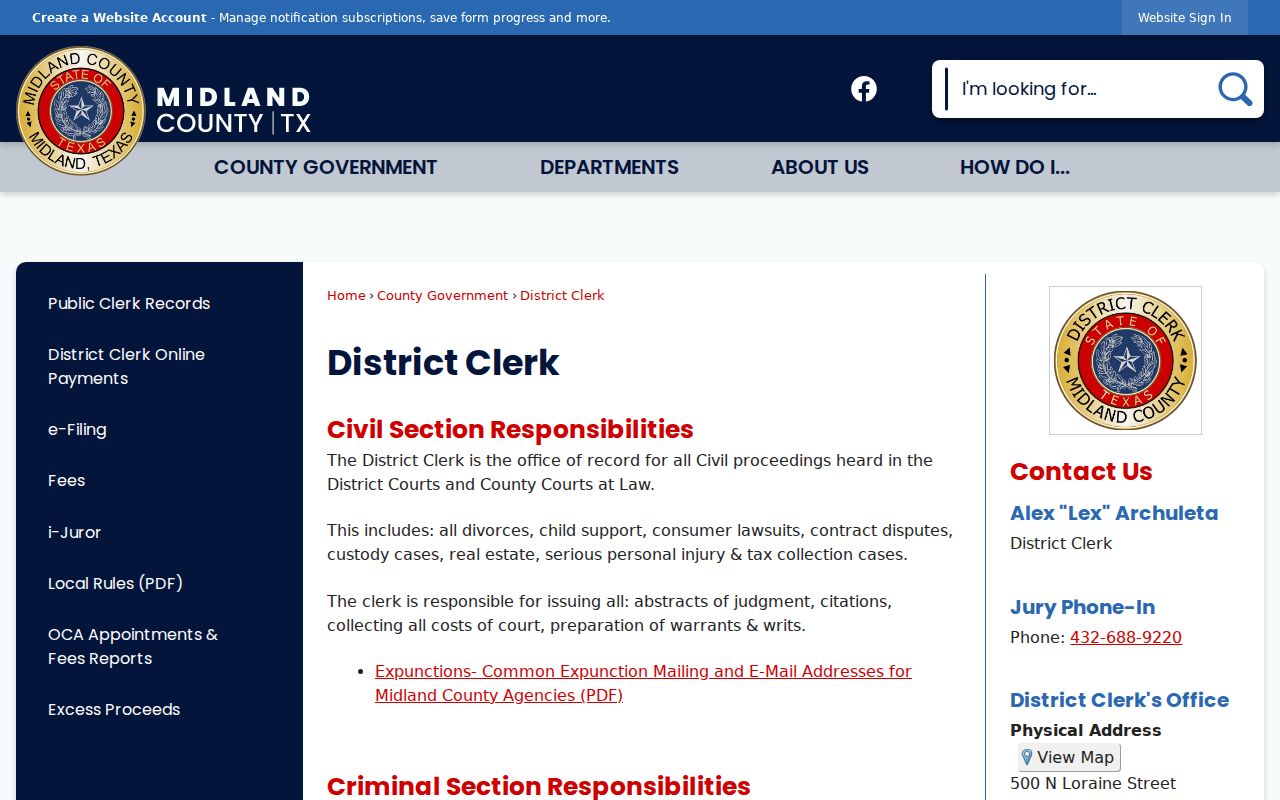
Class A and B misdemeanor records use the County Clerk instead, which makes offense level a vital routing fact.
Criminal Record Types
A single Midland County event can produce several connected files. The arresting officer creates an incident or arrest report. The jail creates booking and custody data. A magistrate records warnings and bond decisions. Prosecutors select the filed charges, and the clerk builds the court docket. Fingerprints and reported outcomes can then enter the DPS criminal-history system. Each product has its own update cycle, access limits, and custodian.
- Incident and arrest reports describe the allegation, response, asserted charges, and investigative steps, subject to lawful redaction.
- Booking records track intake, charge, bond, warrants, custody, and release after admission to the county jail.
- Court case files contain the filed charge, docket, orders, judgment, sentence, costs, and appeal papers.
- Warrant records identify an issuing court and legal command, though sealed and juvenile matters are not public lookup material.
- Supervision and registry records cover different post-case duties and do not function as one general criminal-history result.
The County Clerk misdemeanor page is a direct source for its part of that system.
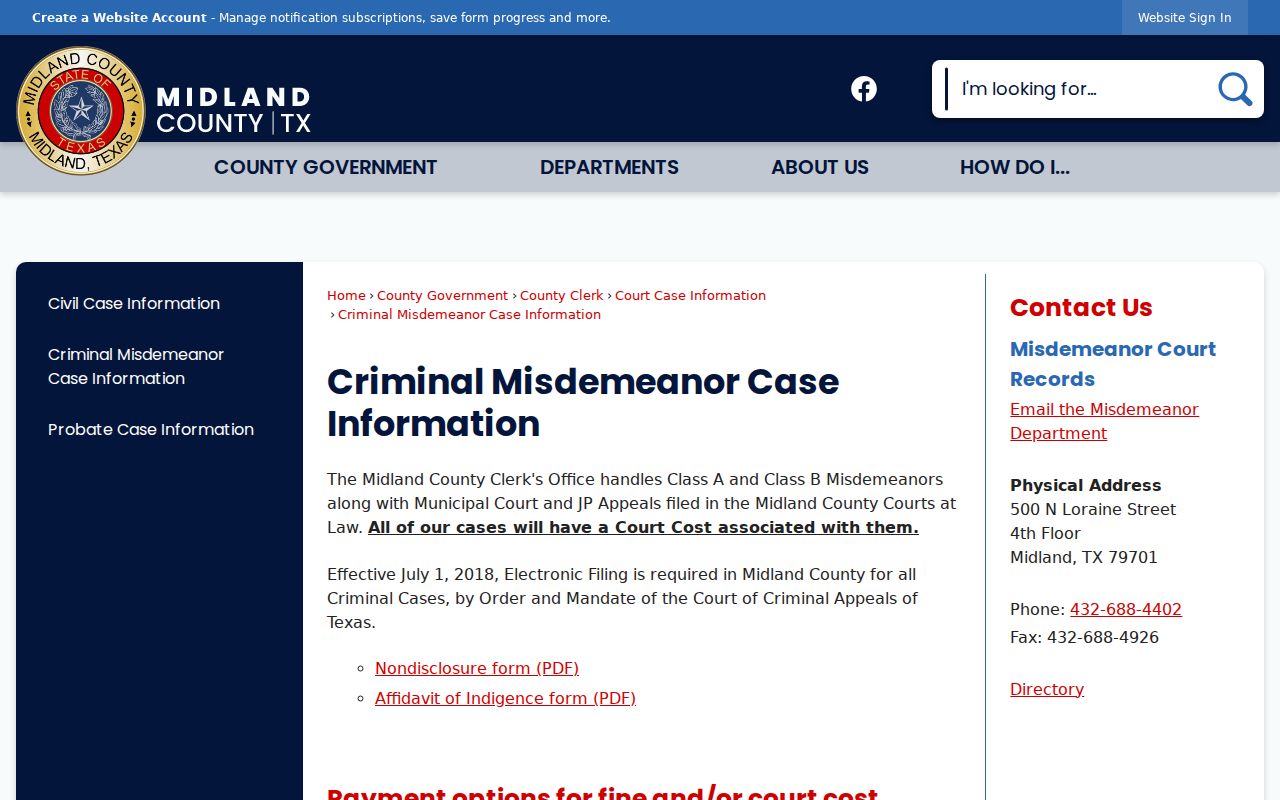
Its jurisdiction differs from felony district court, current jail custody, and city fine-only cases.
Reading Midland County Detainee Records
The sheriff's live list accepts a full or partial last name and also offers a view-all option. The page carries a current-detainee timestamp. It is not a historic arrest index. An entry can show a name and displayed address, attorney, offense wording and class, court, county, warrant or cause number, arrest date, bond, fines, disposition, and sentence units. The inspected list did not show mugshots, booking numbers, dates of birth, or jail housing and medical classifications.
Read the columns separately. Bond is not a fine. A sentence is not an arrest charge. “Pending disposition” means that the court outcome has not been entered there as a conviction. A person who leaves custody can disappear from the current list even though the police report and court file still exist. Historic material then requires Sheriff Records, the arresting agency, or the clerk.
The official current-detainee search displays that operational snapshot.
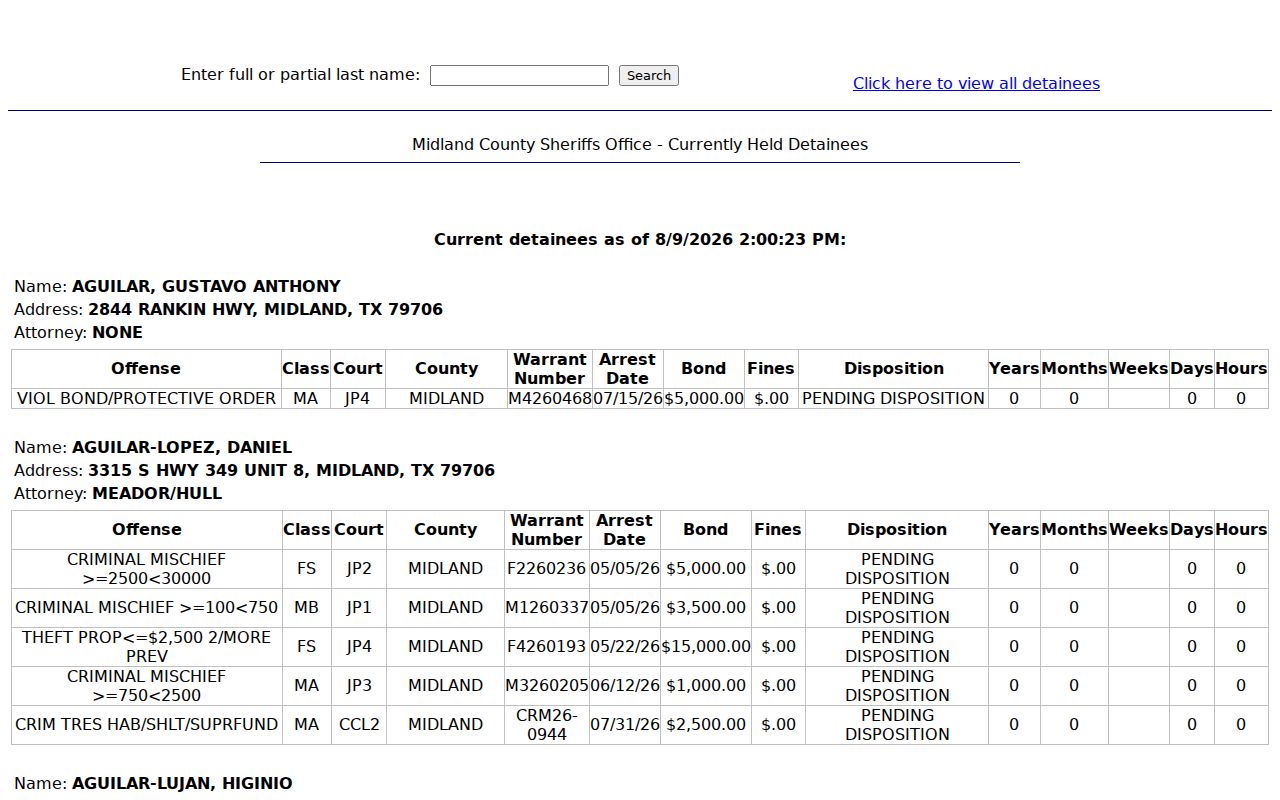
Use its court and warrant fields as leads, then confirm the filed charge and outcome in the source court record.
Note: An arrest or current jail entry is not proof that a court found the person guilty.
Inside a Midland County Criminal Record
A full Texas criminal-history cycle can connect identity data to arrest, prosecution, disposition, sentence, and custody or supervision. Public access is narrower. Midland County pages may show local operational fields, while DPS limits its public name product to public conviction and deferred-adjudication information. The court file supplies the legal documents that explain how an arrest label changed over time.
| Name and identifiers | Name, aliases, date of birth, and sex or race where lawfully released; fingerprint-linked systems may use SID or FBI identifiers. |
|---|---|
| Arrest and booking | Arrest date, arresting agency, asserted charge, warrant, bond, booking, custody, and release data. |
| Charges and statutes | The alleged offense at arrest and the complaint, information, or indictment later filed in court. |
| Disposition | Rejection, dismissal, deferred adjudication, acquittal, plea, conviction, or another final case result. |
| Sentence | Jail or prison term, fine, court costs, or community-supervision terms set by the court. |
| Custody or supervision | County jail, TDCJ custody, community supervision, or parole status through the proper official channel. |
How Midland County Arrest Data Travels
The arresting agency first owns the incident narrative. If the person is booked, the sheriff records identity, charges, warrants, bond, and custody information and normally captures fingerprints. DPS can receive fingerprint-based arrest data through a transaction or control number. The prosecutor then decides what charge to file. A district or county clerk records the case and outcome, and the disposition is reported back to the state repository.
Record flow: Arresting agency › Midland County booking › prosecutor › court clerk › Texas DPS.
Gaps can occur when data arrive late, a fingerprint transaction is rejected, identifiers differ, or a disposition has not yet been reported. That is why a sound self-review compares the agency report, jail entry, clerk docket, and DPS result. The state prison locator adds another layer only after a person enters TDCJ custody.
The TDCJ Online Inmate Search is the official state-custody channel.
A missing TDCJ result says little about a fresh Midland County booking because county and state custody are different systems.
Public Access Laws in Texas
Texas law separates public criminal-history information, local executive-agency records, and judicial records. Government Code section 411.135 permits DPS to release conviction and deferred-adjudication information to any person. The Texas Public Information Act covers many police, sheriff, and local-agency records. It calls for prompt production within a reasonable time, not a blanket promise of delivery in ten days. Courts are excluded from the TPIA definition, so their records follow court rules, statutes, and common law.
Key statutes:
Texas Government Code Chapter 411 sets criminal-history access rules and the nondisclosure framework.
Texas Government Code Chapter 552 governs public information held by executive and local agencies.
Code of Criminal Procedure Chapter 55A governs Texas expunction.
Code of Criminal Procedure Chapter 62 governs sex-offender registration and public notification.
Release can still be limited by juvenile confidentiality, active-investigation rules, victim protections, and laws covering driver's-license, medical, account, and other sensitive data. A custodian may redact fields or seek an Attorney General decision when no prior ruling controls.
Midland County Judicial Record Requests
A public-information request and a judicial-record request are not interchangeable. Send a sheriff report request to Sheriff Records. Send an MPD incident request through the city channel. Ask the proper clerk for pleadings, a docket, judgment, or certified disposition. Midland Municipal Court has its own judicial-record form and states that it will respond within ten business days. Its copies cost $1 per page, with no added certification charge.
For an agency request, describe the event instead of asking the office to answer questions. Provide the subject's name and date of birth, aliases, incident or booking number, a narrow date range, location, arresting unit, and exact record type. The TPIA does not force an agency to create a new record. A focused request also makes estimates and redactions easier to manage.
- Judicial record
- A court-created or court-held file governed outside the ordinary TPIA process.
- Disposition
- The court's outcome for a filed charge, such as dismissal, acquittal, deferred adjudication, or conviction.
- Redaction
- Removal of protected fields from a record that can otherwise be released.
- Cause number
- The court's identifier for a case, often the best key for a clerk search.
Sealed, Expunged, and Restricted Records
Not every Midland County criminal record is open. Juvenile law-enforcement and court files, expunged records, data under an order of nondisclosure, nonpublic criminal-history information, protected victim details, and sensitive identifiers can be hidden or withheld. Redaction removes a field from an otherwise public record. Nondisclosure limits public release while allowing access by specified agencies. Expunction directs named custodians to remove, destroy, or return qualifying records under the court order.
Eligibility depends on the outcome and current law. Texas Chapter 55A includes routes for acquittals, pardons, some dismissals or no-bills after required conditions, and mistaken-identity cases. A conviction is not erased merely because time passed. Deferred adjudication more often leads to a nondisclosure analysis. The offense, wait period, prior history, agency exceptions, and court with jurisdiction all matter.
Midland County Expunction Service Trail
Midland's District Clerk publishes an unusually useful service-address sheet. It identifies DPS, four justice courts, both county clerks, the Sheriff, CSCD, Midland Police, the District Attorney, and other offices that may hold a piece of one arrest history. A petition must name every proper respondent. Leaving out a custodian can leave a copied record beyond the order's reach.
The District Clerk lists a $281 expunction filing fee plus $19 for each agency notified. It lists $313 for a district-clerk nondisclosure matter, including certified-mail notice to DPS, plus $8 per added agency. The County Clerk separately lists $350 for a nondisclosure petition within its jurisdiction. Those figures concern different courts, so identify the underlying case and confirm the current clerk quote before filing.
After an order is entered, obtain certified copies and allow time for each agency to carry it out. Then check the local index and use a later DPS self-review. If a disposition remains wrong, send the certified proof to the source agency and repository rather than assuming one order instantly fixed every database.
Midland County Criminal Records by City
Midland and Odessa are the only incorporated cities that the research supports for Midland County. Midland is the county's principal city. Odessa lies mainly in Ector County but reaches Midland County at the boundary, so its page emphasizes how location, arresting agency, booking county, and issuing court control the search. City police hold their incident reports, while municipal courts keep fine-only city cases.
Midland Criminal Records
2024 estimate: 143,687
MPD reports, city requests, and municipal court files
Odessa Criminal Records
2024 estimate: 119,748 citywide
OPD, municipal court, and county-boundary routing
The Texas Public Sex Offender Registry supplies a separate public-safety search by name or place.
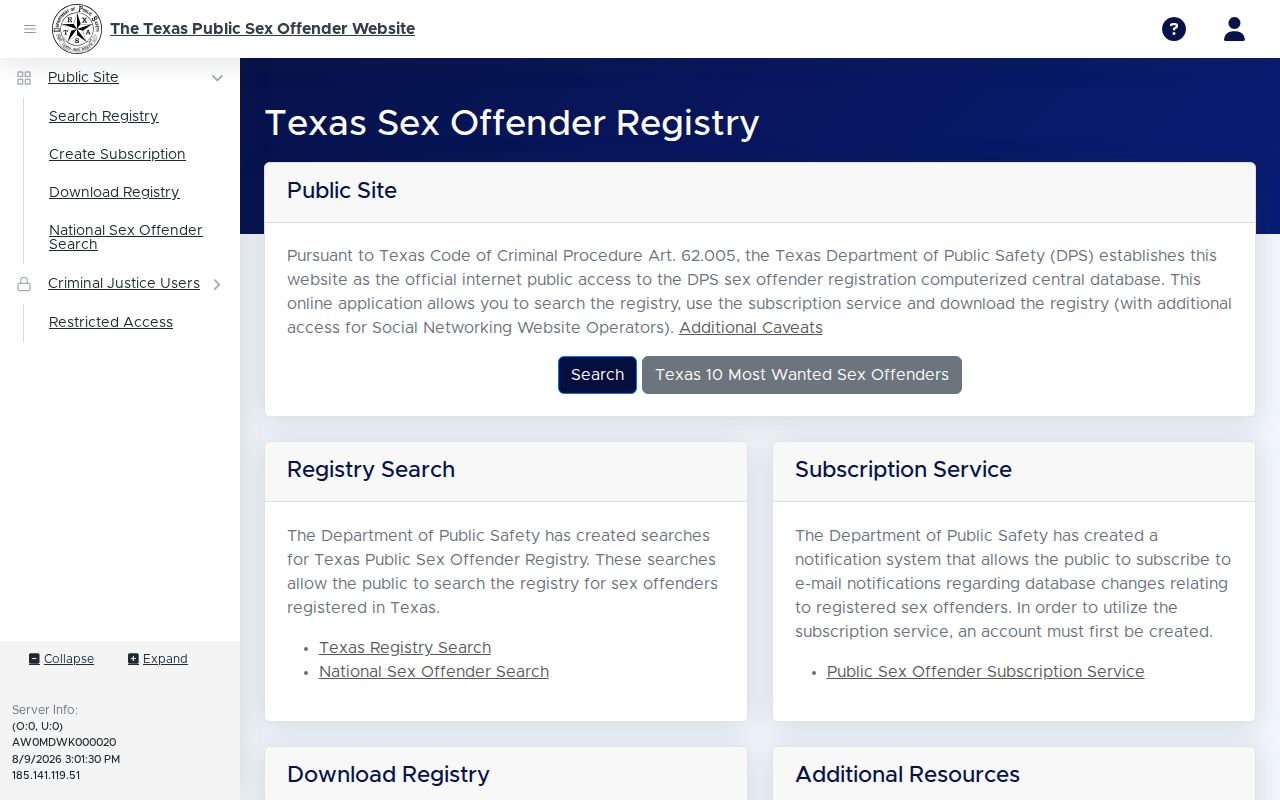
Registry entries are not substitutes for city police reports, booking records, or court dispositions.
Midland County Detention Records Move
County construction makes current contact checking more than a minor detail. Midland County is building the Gary Painter Detention Center at 2700 S. County Road 1140. Project materials describe an 800-bed, roughly 230,000-square-foot complex with intake, release, bond, public visitation, attorney, medical, records, and support space. Notice to proceed was issued May 13, 2024. An October 1, 2025 update listed an anticipated November 20, 2026 completion and said 42.79 percent of the $171,180,883 contract value had been billed.
Until the county announces operational changes, use the current detention and Sheriff Records contacts published by the county rather than an old directory. The project also shows why a saved third-party address can age quickly. Official pages should be checked again before mailing a request or making a visit.
The Western District of Texas illustrates another boundary: federal criminal files remain outside the county clerk system.
Federal dockets, county cases, state custody, and local bookings must be checked through their own official record holders.