
Midland County Criminal Court Cases
Midland County criminal court cases divide by offense level. Texas District Courts hear felony indictments, and the Midland County District Clerk keeps those felony files. The District Clerk dockets indictments, issues court papers, and prepares clerk records for appeals and post-conviction writs. Class A and B misdemeanors go to the County Courts at Law, whose files are kept by the County Clerk. Appeals from municipal and justice courts can also reach that county-level system.
Fine-only state-law and city-ordinance matters remain with Midland Municipal Court unless an appeal changes the record path. Justice courts keep matters within their statutory criminal jurisdiction and issue some warrants. A cause number and court code are therefore more useful than a name alone. They show which clerk controls the authoritative docket, charging instrument, judgment, and sentence. The Midland County District Clerk describes its felony record duties, while the County Clerk explains its separate misdemeanor role.
Municipal and justice matters need the same care. Midland Municipal Court has its own request form for fine-only city cases. A justice court keeps its criminal and warrant papers until an appeal places a new file with the County Clerk. If a detainee entry names a court code, preserve that code exactly. It can distinguish a justice matter from a county or district case. The offense date and arrest date may also differ from the filing date, so include all three when known.
Midland Court Levels and Clerks
The courthouse at 500 N. Loraine Street makes one local distinction quite literal. Felony service is tied to the District Clerk and third-floor area, while the County Clerk's misdemeanor department is on the fourth floor. Asking the County Clerk for a felony file, or asking the District Clerk for a city citation, creates an avoidable transfer. Call the District Clerk at 432-688-4500 for felony records. The County Clerk's Misdemeanor Department uses 432-688-4402, with separate lines for fine and cost questions.
The Texas Judicial Directory can help identify a court or judicial officer before contacting a clerk.
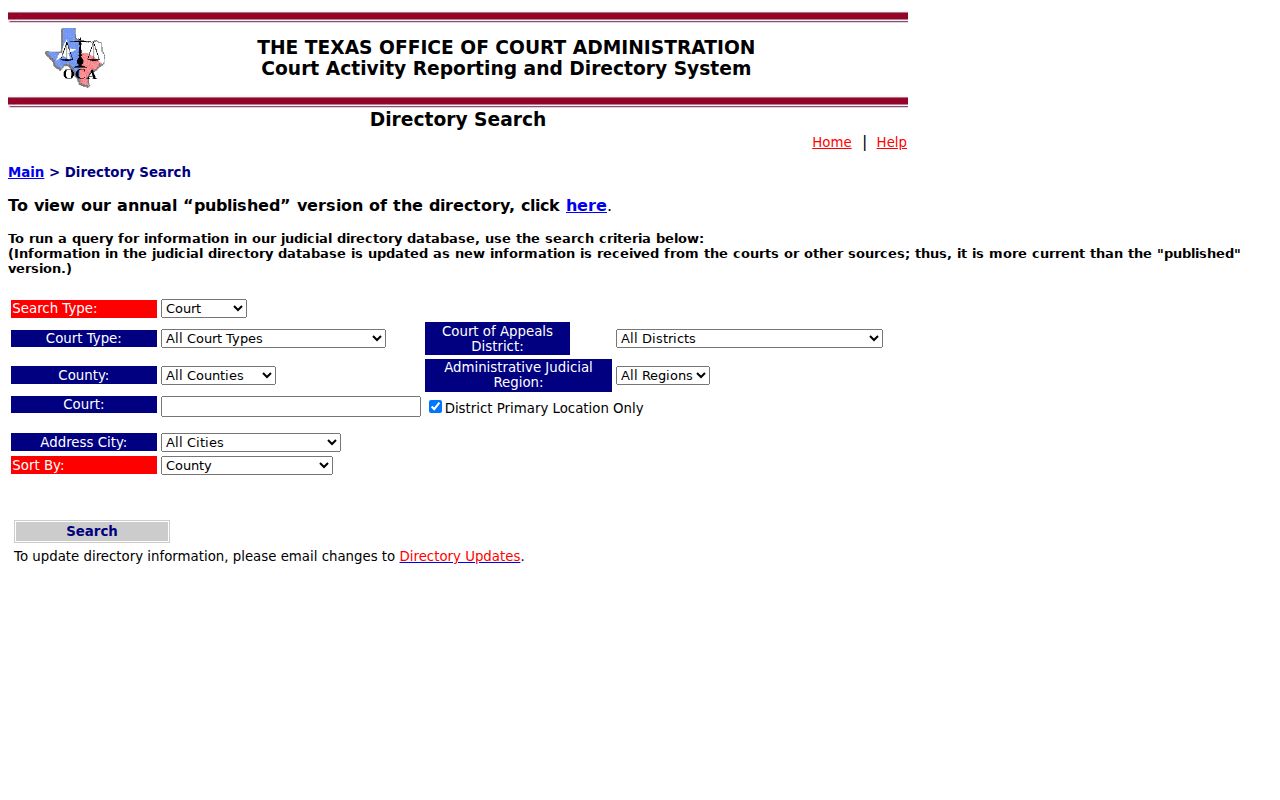
That directory is a routing tool, not the Midland County case file. Confirm the cause number and document availability with the clerk that holds the docket.
Searching Midland County Case Records
Begin with the most precise identifier available. A warrant or cause number from the county detainee list can connect an arrest entry to a court file. If only a name is known, add a filing year, charge level, or date of birth when the system permits. re:SearchTX is the statewide starting point, but court coverage, available document images, account rules, and charges vary. A missing result does not settle whether a Midland County case exists.
- Record the cause or warrant number, court code, charge, and arrest date from any known record.
- Sort the matter into felony, Class A or B misdemeanor, municipal, or justice-court jurisdiction.
- Check re:SearchTX where coverage exists, then compare the name and cause number with the local clerk's docket.
- Ask first for the docket or register of actions, charging instrument, disposition, judgment, and sentence.
- Confirm whether copies are electronic, paper-only, archived, sealed, or available only through a written judicial-record request.
The statewide portal presents search routes that depend on its current account and court coverage. Use the following practical fields when they appear.
| Field Label | Type | Required | Notes |
|---|---|---|---|
| Party name | Text | Search-route dependent | Use full spelling and verify identity with other details. |
| Case number | Text | No | The strongest link to one Midland County docket. |
| Filing year | Date or filter | No | Narrows common names and older records. |
| Case type | Filter | No | Select criminal coverage when the court provides it. |
| Court | Filter | No | Match the local clerk and charge level. |
If the statewide index returns several similar names, do not choose a file by name alone. Compare the cause number, court, filing date, and charge. Then ask the Midland clerk to confirm the identity and current status. re:SearchTX can expose an index where a court participates, yet some document images can be limited or carry a charge. Older and non-indexed files may require direct contact. Buying every image is rarely the best first move. A docket, charging instrument, and judgment often answer the key questions with less cost.
Midland Municipal Case Requests
Midland Municipal Court uses a dedicated web form for pending and closed disposition records. This is a judicial-record channel, not an ordinary public-information request. The subject's name is required. Date of birth and driver or identification number can help distinguish people with similar names. The requester also supplies contact details and chooses certified or non-certified copies. The court charges $1 per page and adds no separate certification fee. It says it will respond within ten business days.
The Municipal Court record request form shows each field and submission choice.
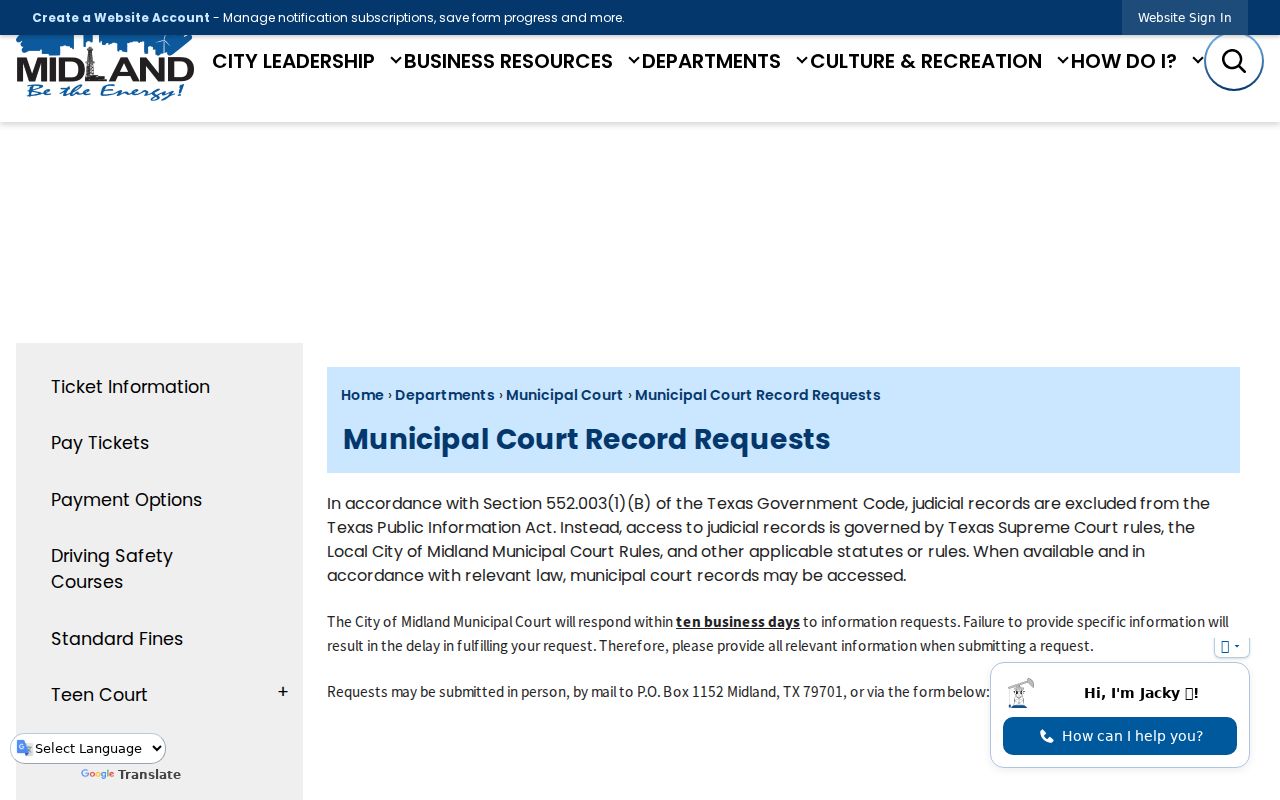
The form is best for city dispositions. A felony indictment or Class A or B misdemeanor still belongs with the proper Midland County clerk.
Inside a Midland County Case File
A Midland County criminal case file records the prosecution, not just the arrest. It can show the filed charge, court events, motions, plea or verdict, final disposition, and sentence. The docket often provides the fastest overview. Document images may require a fee or direct request even when an index is visible. Start with the core records before ordering every filing, especially when the goal is to confirm the outcome of one's own case.
| Cause Number and Court | Identifies the file, assigned court, and level of jurisdiction. |
|---|---|
| Charging Instrument | A complaint, information, or indictment states the charge the prosecutor filed. |
| Docket Entries | Lists settings, appearances, motions, orders, pleas, and other case events. |
| Parties and Counsel | May identify the defendant, prosecutor, and defense counsel in the public record. |
| Disposition and Judgment | Shows dismissal, acquittal, conviction, deferred adjudication, or another final result. |
| Sentence and Costs | May state confinement, community supervision, fines, costs, and public conditions. |
Other useful entries include filing date, assigned judge, case status, bond, motions, orders, costs, restitution when public, and appeal or writ references. The charging instrument answers what the state actually alleged in court. The event docket shows how the matter moved. The judgment answers how the court resolved it. Those records are more reliable for outcome review than a booking row that still says pending. Full dates of birth and other protected identifiers may be masked even when enough information remains to distinguish the case.
Reading Midland Criminal Case Terms
Several labels mark different points in a Midland County case. A complaint is an initial sworn accusation. An information is a prosecutor's charging instrument often used for a misdemeanor. An indictment is the grand jury's felony charging instrument. None alone proves guilt. Likewise, “pending disposition” means the court has not recorded a final outcome. Charge wording can change after prosecutor review, so the filed instrument matters more than the arrest label.
- Arraignment
- The hearing at which the accused is formally called on to answer the filed charge.
- Disposition
- The case result, such as dismissal, acquittal, deferred adjudication, or conviction.
- Judgment
- The court's formal written statement of the result and, when applicable, the sentence.
- Post-conviction writ
- A later challenge to a conviction or sentence kept in the District Clerk's record stream.
Note: A booking charge and filed court charge may differ, so read the charging instrument before relying on a label.
How a Criminal Case Moves
A Midland County criminal court case may start with an arrest or summons, but the prosecutor decides what charge to file. A felony normally proceeds through grand-jury indictment in District Court. Class A and B misdemeanors use the County Courts at Law. After filing, the court handles arraignment, pretrial motions and discovery, then a plea or trial. Judgment and sentencing follow a conviction or deferred result, while an acquittal or dismissal closes the charge through a different disposition.
Case flow: Charges Filed › Arraignment › Pretrial › Plea or Trial › Disposition › Sentencing
Texas law calls for an arrested person to be taken before a magistrate without needless delay, generally within 48 hours. That early magistration concerns warnings, counsel, probable cause, and bond. It is not the final trial or disposition. Appeals and post-conviction writs can extend the record after sentencing.
Older Midland Criminal Case Files
An empty online search is not proof that no Midland County case exists. Older files may be archived, paper-only, or absent from a public index. Records can also be sealed, restricted, or filed under a name variation. Contact the likely clerk with the full name, approximate filing year, charge level, and any cause number. Ask whether the docket can be inspected, sent electronically, or retrieved from an archive.
The Texas OCA fiscal-year reports offer court activity context, but aggregate filings and dispositions do not identify one Midland County case.
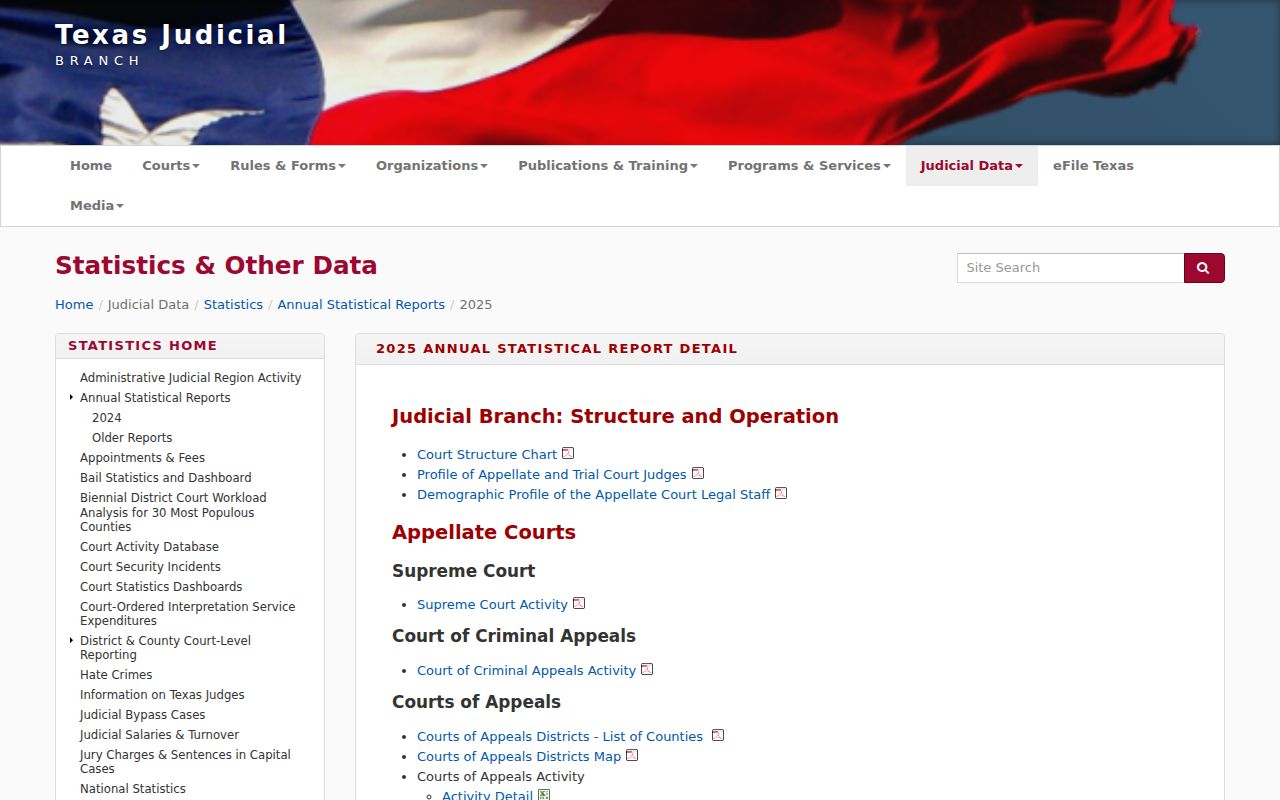
Use those reports for trends only. A clerk's docket and judgment remain the sources for an individual case outcome.
Case Record Access and Restrictions
Judicial records sit outside the ordinary Texas Public Information Act because Government Code §552.003 excludes the judiciary from that law's definition. Court rules, statutes, and common law govern access instead. That distinction matters in Midland County. A police report request may follow the TPIA, while a request for the filed information, docket, judgment, or municipal disposition goes to the court custodian under judicial-record rules.
Public access does not expose every field. Victim identifiers, Social Security numbers, full birth dates, juvenile information, and sealed material can be withheld or redacted. An online view may also show less than the clerk's public file. If a Midland County criminal case does not appear, ask the clerk whether it is archived, non-indexed, sealed, or held by a different court. Do not assume that lack of a web result means the charge never existed.
Juvenile justice records follow Texas Family Code Chapter 58, not the adult lookup path. Expunged records and information covered by an order of nondisclosure can also be removed from public view or restricted. Redaction is narrower: it hides a protected field while the rest of the court record may remain public. These terms are not interchangeable. A person reviewing their own Midland County file should obtain the order or judgment that created the limit and ask the clerk how it has been applied.
Midland and Federal Court Cases
Midland County lies in the Western District of Texas, but federal criminal dockets do not belong to either county clerk. They are searched through PACER and confirmed with the federal court. County dockets may show a local hold or related state charge, yet they cannot stand in for the federal case file. This split is most important when a name appears in custody data but no matching Midland County cause number can be found.
The official PACER court records service explains its account and per-page access system.
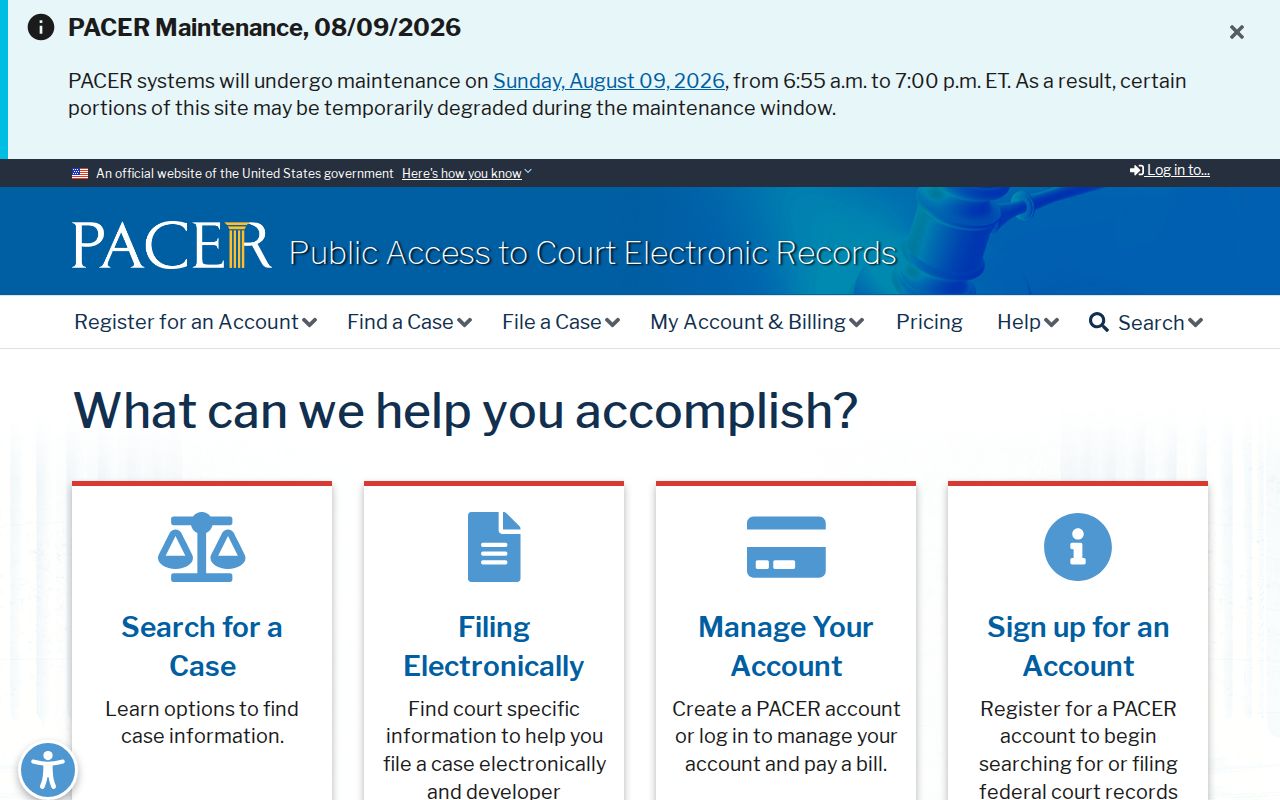
The federal docket is a separate record layer. For broader local context, the Midland County criminal history overview explains how county, state, and federal sources differ.